

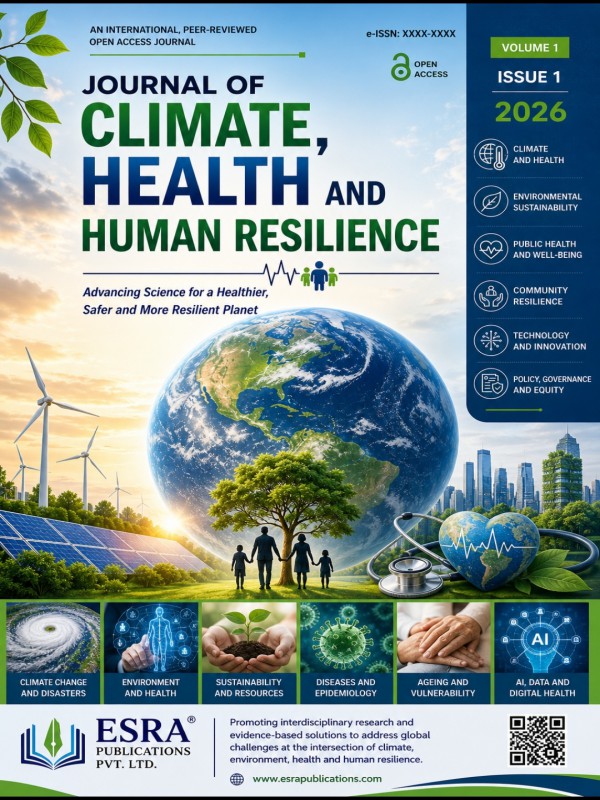
Journal of Climate, Health and Human Resilience
DOI :
language http://esrapublications.com/View-Journal.php?id=35&title=JCHHR
The Journal of Climate, Health and Human Resilience (JCHHR) is an international, peer-reviewed, interdisciplinary, open-access scholarly journal published by ESRA Publications Pvt. Ltd., Bengaluru, India.
The journal provides an international platform for the dissemination of scientific knowledge, original research, critical reviews and evidence-based perspectives addressing the complex relationships between climate change, environmental conditions, human health and societal resilience.
Climate change, environmental degradation, biodiversity loss, air and water pollution, extreme weather events and emerging ecological disturbances increasingly influence human health, healthcare systems, livelihoods and socioeconomic stability. Recognising the interconnected nature of these challenges, JCHHR promotes interdisciplinary research integrating climate science, environmental studies, medicine, public health, epidemiology, biological sciences, engineering, technology, social sciences and public policy.
The journal welcomes contributions addressing climate-sensitive diseases, environmental epidemiology, occupational and community health, sustainable healthcare, food and water security, mental health, vulnerable populations, disaster preparedness, environmental justice, climate adaptation and mitigation, and innovative technological solutions for building resilient communities.
JCHHR particularly encourages research translating scientific evidence into practical interventions, sustainable development strategies, effective healthcare approaches and equitable public policies.
The journal publishes original research articles, narrative and systematic reviews, meta-analyses, short communications, case studies, methodological papers, policy analyses, perspectives and other relevant scholarly contributions.
Through interdisciplinary collaboration and evidence-based scholarship, JCHHR aims to contribute to global scientific understanding and practical solutions for protecting human health, strengthening community resilience and promoting environmental sustainability.
The journal follows a transparent editorial process and rigorous peer-review standards. It is committed to publication ethics, research integrity, accessibility and the responsible dissemination of scientific knowledge.
JCHHR operates as an open-access journal, making its published research freely accessible to readers worldwide.
Aim
The primary aim of the Journal of Climate, Health and Human Resilience is to advance interdisciplinary scientific research and evidence-based knowledge concerning the effects of climate change and environmental transformations on human health, ecosystems, communities and socioeconomic systems.
The journal seeks to encourage innovative research, scientific collaboration and practical solutions that strengthen climate adaptation, environmental sustainability, public health preparedness and human resilience.
It aims to bridge the gap between scientific discoveries, healthcare practices, technological innovation and public policy, supporting the development of healthier, safer, more sustainable and climate-resilient societies.
A. Climate Science and Environmental Change
-
Climate change, global warming and atmospheric processes
-
Greenhouse gases and carbon emissions
-
Climate modelling, forecasting and prediction
-
Extreme weather events, heatwaves, floods, droughts and cyclones
-
Environmental pollution and ecological degradation
-
Ozone depletion and atmospheric chemistry
-
Climate variability and regional climate patterns
-
Urbanisation, urban heat islands and environmental transformation
B. Climate Change and Human Health
-
Climate-sensitive diseases and health outcomes
-
Heat stress, heatstroke and temperature-related mortality
-
Respiratory diseases and air-pollution-related illnesses
-
Cardiovascular and metabolic disorders associated with environmental change
-
Vector-borne diseases, including malaria, dengue and other emerging infections
-
Waterborne and foodborne diseases
-
Nutritional deficiencies and food insecurity
-
Maternal, child and reproductive health under changing climatic conditions
-
Occupational and environmental health
-
Climate change and healthcare-associated risks
C. Public Health, Epidemiology and Preventive Medicine
-
Environmental epidemiology
-
Climate-related disease surveillance
-
Public health preparedness and emergency response
-
Health risk assessment and disease-burden studies
-
Community health and preventive healthcare
-
One Health and planetary health approaches
-
Healthcare infrastructure and climate preparedness
-
Environmental determinants of health
-
Health inequalities and vulnerable communities
D. Mental Health, Ageing and Human Vulnerability
-
Climate anxiety and psychological distress
-
Depression, stress and trauma following environmental disasters
-
Mental health consequences of displacement
-
Climate-related health risks among older adults
-
Children, women and vulnerable populations
-
Disability, chronic illness and environmental vulnerability
-
Social isolation, community support and psychological resilience
E. Environmental Sustainability and Natural Resources
-
Sustainable development and environmental conservation
-
Biodiversity, ecosystems and human health
-
Forest conservation and ecosystem restoration
-
Water conservation and sustainable water management
-
Soil health, agricultural sustainability and food security
-
Renewable energy and clean technologies
-
Waste management and circular economy
-
Sustainable cities and green infrastructure
-
Nature-based solutions and ecosystem services
F. Community Resilience, Disaster Management and Adaptation
-
Community-based climate adaptation
-
Disaster risk reduction and management
-
Climate-resilient infrastructure
-
Emergency healthcare systems
-
Food, water and energy security
-
Migration, displacement and climate refugees
-
Rural and urban community resilience
-
Indigenous knowledge and traditional adaptation strategies
-
Recovery and rehabilitation following environmental disasters
G. Technology, Innovation and Digital Health
-
Artificial intelligence in climate and health research
-
Machine learning for disease prediction
-
Remote sensing and geographical information systems
-
Digital epidemiology and health surveillance
-
Climate-health early warning systems
-
Telemedicine and remote healthcare
-
Smart healthcare infrastructure
-
Environmental monitoring technologies
-
Big data, predictive analytics and health informatics
-
Sustainable engineering and green technology
H. Policy, Governance, Economics and Environmental Justice
-
National and international climate policies
-
Public health legislation and environmental governance
-
Climate finance and sustainable investment
-
Environmental economics and health economics
-
Climate justice and health equity
-
Sustainable development goals
-
Corporate environmental responsibility
-
Healthcare policy and climate adaptation
-
International cooperation and climate agreements
-
Socioeconomic consequences of environmental change
I. Food, Agriculture and Nutritional Security
-
Climate change and agricultural productivity
-
Food systems and nutritional security
-
Crop adaptation and climate-resilient agriculture
-
Food safety and environmental contamination
-
Agricultural biodiversity
-
Sustainable food processing and preservation
-
Nutrition-related consequences of climate change
-
Food supply chains and economic vulnerability
J. Interdisciplinary and Emerging Research
-
Planetary health
-
Ecohealth and One Health
-
Human-environment interactions
-
Climate change and infectious disease emergence
-
Sustainable healthcare and low-carbon hospitals
-
Traditional knowledge and environmental health
-
Innovative approaches to human resilience
-
Interdisciplinary solutions for global environmental challenges
Types of manuscripts accepted
|
Article category |
Description |
|---|---|
|
Original Research Articles |
New experimental, observational, clinical, epidemiological or computational research |
|
Narrative Reviews |
Comprehensive discussion of emerging or established subjects |
|
Systematic Reviews |
Structured evidence-based literature reviews |
|
Meta-analyses |
Quantitative synthesis of published research |
|
Short Communications |
Important preliminary findings |
|
Mini Reviews |
Focused reviews of specialised topics |
|
Case Studies |
Environmental, public-health and community-related cases |
|
Policy Reviews |
Analysis of environmental and public-health policies |
|
Perspectives |
Expert opinions and emerging research directions |
|
Methodological Papers |
Novel research techniques, tools and analytical methods |
|
Data-driven Studies |
Climate, environmental and population-health datasets |
|
Letters to the Editor |
Scholarly comments and discussions |
|
Editorials |
Invited contributions from editors and experts |
|
Special Issue Articles |
Research addressing a specific announced theme |
Professor M. A. PASHA (Retd.,)
Editor-in-Chief
Department of Chemistry
Bangalore University
Bengaluru, INDIA
E-mail: chief.editoresra@gmail.com
Dr. Thavanayagam Mathiventhan
Assistant Professor
Department of Botany,
Faculty of Science, Eastern University,
SRI LANKA (EUSL)
E-mail: tmathiventhan@yahoo.com, tmathiventhan@gmail.com
Dr. Sadeq Hamood Saleh Azam
Sana’a University, Faculty of Science,
Chemistry Departement, Sana’a,
YEMEN
E-mail: azam.sadeq@gmail.com
Note: 1. Editor/s-in-Chief, Associate Editors, Assistant Editors, Editorial board members, Reviewers and other Members do not receive any honorarium or remuneration. These are nominated positions and are voluntarily accepted by the individual academicians.
2. If a Researcher/Scientist/Academician working in this field is voluntarily agreeing to be an Editor or a member of the Editorial Board, kindly submit your Resume/CV to chief.editoresra@gmail.com [mention the email subject: Interested to serve as an Editor/Editorial Board Member].
Instructions for Authors and Manuscript Preparation Guidelines
ESRA Publications welcomes original and significant scholarly contributions from researchers, scientists, academicians, engineers, healthcare professionals, students and other members of the academic community worldwide.
These guidelines provide instructions for preparing and submitting manuscripts to journals published by ESRA Publications. Authors should also consult the Aims and Scope, Author Guidelines, Publication Ethics Policy and Publication Charges of the specific journal before submission, as requirements may vary between journals and disciplines.
1. Types of Publications
ESRA Publications considers the following types of scholarly contributions, subject to the scope and policies of the individual journal.
1.1 Original Research Articles
Original research articles should present novel findings based on systematic investigation, experimentation, observation, modelling, computation, fieldwork or other appropriate research methods.
A typical research article includes a title, abstract, keywords, introduction, materials and methods or methodology, results, discussion, conclusion, declarations and references.
1.2 Review Articles
Review articles should provide a critical, comprehensive and well-organized synthesis of published literature on a specific research topic. They should identify major developments, compare findings, discuss limitations and research gaps, and suggest directions for future research.
Review articles should not merely summarize individual publications. Authors should explain how the literature was identified and selected, where appropriate.
For systematic reviews and meta-analyses, authors should follow relevant reporting guidelines, such as PRISMA, where applicable.
A typical review article includes:
-
Title
-
Abstract
-
Keywords
-
Introduction and objectives
-
Review methodology or literature-search strategy, where appropriate
-
Thematic sections or critical analysis of the literature
-
Discussion of research gaps and future directions
-
Conclusions
-
Declarations
-
References
1.3 Case Reports and Case Studies
Case reports should describe a relevant clinical, scientific, engineering, educational, technical or other scholarly case with a clear purpose and meaningful contribution to the field.
Medical and healthcare case reports should include relevant clinical information, diagnostic findings, interventions, outcomes and discussion, as appropriate. Patient consent and ethical requirements must be satisfied wherever applicable.
Engineering, technical and other case studies should describe the context, methods, observations, outcomes and lessons learned.
A typical case report may include:
-
Title
-
Abstract
-
Keywords
-
Introduction
-
Case presentation or case description
-
Findings, observations or results
-
Discussion
-
Conclusion
-
Consent and ethical declarations, where applicable
-
References
1.4 Short Communications and Technical Notes
Short communications should present concise, significant findings, preliminary research results, methodological advances, technical developments or focused scholarly observations.
The structure and length should be appropriate to the journal's requirements.
1.5 Academic and Student Project Reports
ESRA Publications considers suitable undergraduate and postgraduate project reports, including work associated with B.E., B.Tech., M.E., M.Tech. and other Bachelor's and Master's degree programmes.
Project reports should clearly describe the problem addressed, objectives, background, methodology, results, discussion, conclusions and references, as applicable.
Reports must satisfy relevant academic, editorial, ethical and formatting requirements. Completion of an examination or academic project does not automatically guarantee publication.
Authors must ensure that institutional rules, permissions and confidentiality requirements are observed.
1.6 Conference Proceedings
Conference, seminar, symposium and workshop contributions may be considered for publication subject to the relevant publication arrangements and editorial requirements.
Authors and organizers should provide the event details, titles, author information and any required permissions. ISBN assignment, where applicable, is subject to the relevant requirements.
1.7 Books, Book Chapters and e-Books
Book proposals, edited volumes, research monographs and individual book chapters may be submitted for consideration.
Proposals should normally include the proposed title, subject area, objectives, intended readership, table of contents, author or editor biographies and a description of the work's scholarly contribution.
Acceptance, editorial review, publication format, copyright, ISBN arrangements and applicable charges will be communicated separately.
1.8 Other Scholarly Contributions
Depending on the journal, ESRA Publications may also consider perspectives, commentaries, methodological papers, educational articles, letters to the editor, editorials and other scholarly contributions.
Authors should confirm whether the intended article type is accepted by their selected journal.
2. Manuscript Preparation and Formatting
Authors should prepare manuscripts using Microsoft Word software and follow the formatting requirements below unless the individual journal specifies otherwise.
-
Font: Times New Roman.
-
Title: 14-point font, preferably bold.
-
Main text: 12-point font.
-
Line spacing: Double spacing throughout the manuscript, including references, unless otherwise specified.
-
Text alignment: Left-aligned text is recommended.
-
Margins: Approximately 2.5 cm (1 inch) on all sides.
-
Page numbering: Number all pages consecutively.
-
Headings: Use clear, consistent headings and subheadings.
-
Paragraphs: Maintain consistent paragraph formatting.
-
Language: Use clear, concise and grammatically correct English, unless the journal accepts another language.
-
File format: Submit the manuscript as a Microsoft Word document, preferably .docx.
-
Tables and figures: Number consecutively and provide appropriate titles, captions and explanatory notes.
Authors must spell-check and grammar-check their manuscripts before submission. Language-editing tools may be used, but authors remain responsible for the accuracy and meaning of the final text.
The manuscript should be organized logically, with sections appropriate to the type of publication and the requirements of the selected journal.
3. Title Page and Author Information
The title should be concise, informative and representative of the content of the manuscript. Avoid unnecessary abbreviations, excessive wording and unsupported claims.
The title page should include the following information:
3.1 Title of the Manuscript
Provide the complete title of the article, case report, review or project report.
3.2 Author Names
Provide the full names of all authors in the intended order of authorship.
3.3 Institutional Affiliations
Include the department, institution or organization, city, postal code where applicable, and country for each author.
Where authors belong to different institutions, identify the corresponding affiliations clearly using superscript numbers or another consistent method.
3.4 Corresponding Author
Designate one author as the corresponding author and provide:
-
Full name
-
Institutional affiliation
-
Complete postal address
-
E-mail address
-
Telephone number, including country code where appropriate
Fax details may be provided if relevant, but are not mandatory.
The corresponding author is responsible for communication with the journal during submission, peer review and publication.
3.5 Authorship Responsibility
All listed authors should have made an appropriate scholarly contribution to the work, approved the final manuscript and agreed to its submission.
Individuals who do not meet the authorship criteria may be acknowledged, where appropriate, with their permission.
4. Abstract and Keywords
4.1 Abstract
Provide a concise abstract describing the purpose, approach, main findings and conclusions of the work.
For original research articles, a structured abstract with headings such as Background, Objectives, Methods, Results and Conclusion may be used where appropriate.
For review articles, the abstract should summarize the topic, scope, principal findings and implications of the review.
For case reports, it should summarize the case, key observations and relevant conclusions.
For project reports, it should state the objectives, methodology, principal outcomes and conclusions.
The abstract should normally be approximately 150–250 words, unless the journal specifies a different limit.
Avoid references, unexplained abbreviations and claims not supported by the manuscript.
4.2 Graphical Abstract
A graphical abstract may be submitted where requested or permitted by the journal. It should visually summarize the principal concept, method or findings of the work.
All graphical content must be accurate, appropriately labelled and compliant with applicable copyright and research-integrity requirements.
4.3 Keywords
Provide up to six keywords or key phrases that accurately represent the subject matter of the manuscript.
Choose specific terms that may help readers discover the article through academic searches. Avoid repeating the entire title unnecessarily.
5. Recommended Structure of an Original Research Article
The following structure is recommended for original research articles. Authors should adapt it to the relevant discipline and journal requirements.
1. Introduction
Explain the background, significance and context of the research. Identify the problem or knowledge gap and state the objectives or research questions.
2. Materials and Methods / Methodology
Describe the materials, equipment, study design, procedures, data sources, analytical methods and statistical techniques in sufficient detail to support evaluation and, where applicable, reproducibility.
For research involving human participants, animals or sensitive data, include the relevant ethical information and approval details.
3. Results
Present the findings clearly and logically. Use tables, figures and statistical summaries where appropriate.
Avoid duplicating all the information in tables and figures in the main text.
4. Discussion
Interpret the findings in relation to the research objectives and relevant literature. Discuss the significance, strengths, limitations and implications of the results.
The Results and Discussion sections may be combined when appropriate for the discipline or journal.
Subsections may be numbered consistently, for example:
-
2.1
-
2.2
-
2.2.1
-
2.2.2
5. Conclusions
Summarize the principal findings and their significance. Conclusions should be supported by the results and should not introduce new findings.
Recommendations and future research directions may be included where appropriate.
6. Acknowledgements
Acknowledge individuals, institutions or organizations that provided meaningful assistance but do not qualify for authorship. Obtain permission from individuals named in the acknowledgements where appropriate.
7. Funding / Financial Assistance
Identify the funding agency, grant number and relevant funding details, if applicable.
If the research received no external funding, authors may state:
“This research received no external funding.”
Where applicable, disclose the role of the funding agency in study design, data collection, analysis, interpretation and manuscript preparation.
8. Conflict of Interest
Disclose any financial, professional, personal or other interests that could reasonably be perceived to influence the research or its presentation.
If no relevant conflicts exist, authors may state:
“The authors declare no conflict of interest.”
9. Ethical Approval and Consent
Include statements concerning ethical approval, informed consent, consent for publication and other applicable requirements.
If ethical approval was not required, provide an explanation where appropriate and consistent with the relevant institutional and journal policies.
10. Author Contributions
Where required by the journal, describe the contributions of individual authors, including conceptualization, methodology, investigation, data analysis, writing and supervision.
11. Data Availability Statement
Where applicable, state whether the supporting data are available, where they can be accessed and any restrictions on access.
12. AI Use Declaration
Where generative AI or AI-assisted technologies have materially contributed to manuscript preparation, authors should disclose their use in accordance with the ESRA Publications AI Policy and the requirements of the selected journal.
AI systems must not be listed as authors. Authors remain responsible for the accuracy, originality and integrity of the manuscript.
13. References
List all cited sources in a consistent format, following the citation style prescribed by the journal.
6. Structure of Review Articles
Review articles should provide a coherent and critical assessment of existing scholarship rather than a collection of unrelated summaries.
A recommended structure is:
-
Title
-
Abstract
-
Keywords
-
Introduction and objectives
-
Review methodology or literature-search strategy, where applicable
-
Thematic sections reviewing and comparing the literature
-
Critical analysis of existing evidence
-
Research gaps, limitations and future directions
-
Conclusions
-
Funding, conflicts of interest and other applicable declarations
-
References
Authors should use reliable and relevant scholarly sources and ensure that citations support the claims made.
For systematic reviews and meta-analyses, authors should provide sufficient methodological detail to explain the search strategy, eligibility criteria, study selection, data extraction and synthesis methods. Relevant reporting guidelines should be followed where applicable.
7. Structure of Project Reports
Project reports should be organized according to the discipline, nature of the project and institutional requirements.
A suggested structure is:
-
Title page
-
Student author name(s) and institutional affiliation(s)
-
Supervisor or project guide details, where applicable
-
Declaration or certificate, where required and authorized
-
Abstract or executive summary
-
Keywords
-
Table of contents
-
List of figures and tables, where appropriate
-
Introduction and background
-
Problem statement and objectives
-
Literature review
-
Materials, tools and methodology
-
Design, implementation or experimental work
-
Results and discussion
-
Conclusions and recommendations
-
Limitations and future scope
-
Acknowledgements
-
References
-
Appendices and supplementary material, where applicable
Authors should ensure that project reports comply with relevant institutional policies, permissions and confidentiality requirements.
Where a report includes work conducted by a team, contributions should be acknowledged appropriately and authorship should reflect actual scholarly contributions.
8. Structure of Case Reports
The organization of a case report should reflect the nature of the case and the relevant journal's requirements.
Authors should normally include:
-
Title
-
Abstract
-
Keywords
-
Introduction and rationale
-
Case presentation or description
-
Relevant observations, findings or investigations
-
Intervention or approach, where applicable
-
Outcome and follow-up, where applicable
-
Discussion
-
Conclusions or lessons learned
-
Consent and ethical statements, where applicable
-
References
Medical case reports must protect patient privacy and include appropriate consent for publication when required. Authors should follow relevant case-reporting guidance, such as CARE, where applicable.
Case reports in Ayurveda, Homoeopathy, Unani, Yoga and other complementary or integrative health fields should provide sufficiently clear information about the case, the intervention, the outcome and the limitations of the evidence. Claims of efficacy must be proportionate to the evidence presented.
9. Figures, Images, Schemes and Tables
9.1 Figures and Images
All figures should be numbered consecutively in the order in which they are cited in the manuscript.
Each figure must have a clear caption that explains its content. Define symbols, abbreviations and units where necessary.
Figures should be of sufficient quality for publication. Authors must ensure that images are accurate and have not been manipulated in a manner that misrepresents the underlying evidence.
9.2 Schemes and Diagrams
Schemes, flowcharts, technical drawings and diagrams should be clearly labelled, readable and relevant to the manuscript.
9.3 Tables
Tables should be numbered consecutively and supplied with descriptive titles.
Include explanatory notes, definitions, units, statistical information and source citations where necessary.
Tables should be understandable without requiring readers to search extensively through the main text.
9.4 Copyright and Permissions
Authors must obtain the necessary permission to reproduce copyrighted figures, photographs, tables, diagrams or other materials from third parties, including online sources, unless reuse is otherwise permitted under the applicable licence or law.
Evidence of permission should be supplied when requested or required.
9.5 Supplementary Material
Supplementary data, datasets, appendices, extended tables, additional figures, code or other supporting files may be submitted where relevant.
Supplementary material should be clearly identified, appropriately described and referenced in the manuscript. Authors are responsible for ensuring that it does not contain confidential or unauthorized information.
10. References and Citation Style
Authors must cite all sources used in the manuscript and ensure that each in-text citation corresponds to an entry in the reference list.
Where a journal follows the ESRA numbered-reference style, citations should be presented as superscript Arabic numerals, in the order of first appearance, for example:
The method has been described previously.^1
Related sources may be cited together, for example, ^2–4 or ^5,6.
Authors should check the individual journal's requirements because citation styles may differ across disciplines.
10.1 Journal Article
Example:
[1] S. Al-B. Abdullah, S. S. Tamer, M. Z. Ehab, Ultrasonics Sonochemistry, 2013, 20, 1194–1202.
10.2 Journal Article with a DOI
Example:
[2] M. K. Slifka, J. L. Whitton, “Clinical implications of dysregulated cytokine production,” Journal of Molecular Medicine, 2000. https://doi.org/10.1007/s001090000086.
10.3 Book
Example:
[3] J. L. Luche, T. J. Mason, Sonochemistry: Experimental to Theoretical Considerations, Advances in Sonochemistry, JAI Press, London, 1993.
10.4 Chapter in an Edited Book
Example:
[4] B. Brown, M. Aaron, “The politics of nature,” in: J. Smith (ed.), The Rise of Modern Genomics, 3rd ed., Wiley, New York, 2001, pp. 230–257.
10.5 Website
Example:
[5] J. Bean, “How the Internet Has Changed (and Created New) Holiday Rituals,” available at: https://www.techerator.com/2010/11/how-the-internet-has-changed-and-created-new-holiday-rituals/, 2010. Accessed 21 October 2026.
Note: The references above illustrate formatting only. Authors should independently verify bibliographic details, titles, publication information and DOI links before submission. Do not cite sources that cannot be verified.
11. Statistical Analysis and Research Reproducibility
Where statistical analysis is used, authors should identify the statistical methods, relevant software and versions, significance thresholds and other information needed to interpret the results.
Report sample sizes, units of measurement, uncertainty estimates and relevant statistical values where appropriate.
For computational, engineering and experimental research, provide sufficient methodological detail to permit meaningful assessment and, where feasible, reproducibility.
Authors must not fabricate or falsify observations, datasets, images, statistical outputs or research results.
12. Ethical Requirements
Authors must comply with applicable research ethics requirements and the ethical policies of the relevant journal.
12.1 Human Participants
Research involving human participants or identifiable personal information must comply with applicable ethical and legal requirements. Ethical approval and informed consent should be documented where required.
12.2 Animal Research
Research involving animals must comply with applicable animal welfare requirements and institutional approvals. Provide the relevant committee name and approval information where applicable.
12.3 Clinical and Healthcare Reports
Authors should provide relevant ethical and consent declarations. Identifiable patient information must not be disclosed without appropriate authorization and consent.
12.4 Plagiarism and Duplicate Publication
Manuscripts must be original and must appropriately acknowledge all sources.
Plagiarism, duplicate publication, data fabrication, data falsification, improper authorship and other forms of research misconduct are unacceptable. Suspected misconduct may be investigated in accordance with ESRA Publications' publication ethics policies.
13. Authorship, Originality and Exclusive Submission
By submitting a manuscript, authors confirm that:
-
The work is original and has been prepared with appropriate acknowledgement of all sources.
-
The manuscript has not been published previously, except for permitted forms of prior dissemination, such as an abstract, conference contribution or academic thesis, where applicable.
-
The manuscript is not simultaneously under consideration for publication elsewhere.
-
All listed authors have approved the final manuscript and agreed to its submission.
-
Any required institutional or organizational authorization has been obtained.
-
Necessary permissions have been obtained for third-party material.
-
All relevant funding sources and conflicts of interest have been disclosed.
-
The submission complies with applicable ethical requirements and the policies of the selected journal.
If the manuscript is accepted, authors must comply with the applicable copyright, licensing and publishing agreement. Any subsequent publication or reuse must be consistent with those terms.
14. Suggested Reviewers
Where requested by the journal, authors may provide the names and professional contact details of up to five qualified potential reviewers with expertise relevant to the manuscript.
For each suggested reviewer, provide:
-
Full name
-
Institutional affiliation
-
Official institutional e-mail address
-
Relevant research expertise
-
ORCID or institutional profile, where available
Suggested reviewers should be independent of the authors and should not have conflicts of interest that could compromise an objective assessment.
Authors should not suggest individuals with whom they have inappropriate personal, financial, supervisory or collaborative relationships that could affect impartiality.
The journal retains sole discretion over reviewer selection. Suggested reviewers are not guaranteed to be invited, and authors should follow the specific journal's instructions on whether reviewer suggestions are required.
15. Declaration of Funding and Conflicts of Interest
All authors must disclose relevant funding and potential conflicts of interest.
If the research received no external funding, authors may state:
“This research received no external funding.”
If no relevant conflict of interest exists, authors may state:
“The authors declare no conflict of interest.”
These statements should reflect the actual circumstances of the research. Any additional declaration required by the journal must also be supplied.
16. Artificial Intelligence and AI-Assisted Tools
Authors must follow the ESRA Publications AI and AI-Assisted Technologies Policy and any additional requirements specified by the selected journal.
AI tools must not be listed as authors. Authors remain responsible for the accuracy, originality, citations, data, analysis and conclusions in the submitted manuscript.
Where generative AI or AI-assisted technologies have materially contributed to manuscript preparation, authors should disclose the tool and its purpose as required by the applicable policy.
Authors must independently verify AI-generated references and factual claims. AI tools must not be used to fabricate data, manipulate scientific evidence, misrepresent findings or breach confidentiality.
17. Manuscript Submission Checklist
Before submitting the manuscript, authors should confirm the following:
-
The manuscript fits the aims and scope of the selected journal.
-
The title is concise and informative.
-
All author names and affiliations are complete and accurate.
-
A corresponding author has been designated and contact details supplied.
-
The abstract and keywords are included where required.
-
The manuscript follows the prescribed formatting guidelines.
-
Spelling, grammar, terminology and references have been checked.
-
All tables, figures and supplementary files are properly labelled.
-
All cited sources appear in the reference list and vice versa.
-
Required ethical approval and consent statements are included.
-
Funding, conflict-of-interest and other applicable declarations are provided.
-
Any required AI-use declaration has been included.
-
Copyright permissions have been obtained for third-party material where necessary.
-
The work is not under simultaneous consideration elsewhere.
-
All authors have approved the manuscript and its submission.
-
Suggested reviewers have been provided if required by the journal.
-
The manuscript and accompanying files are ready for submission.
18. Submission Procedure
Authors should submit manuscripts through the online submission system of the relevant ESRA journal, following the instructions displayed on the website.
If authors experience technical difficulties with the online submission or login process, they may contact:
E-mail: submit@esrapublications.com
Alternative contact: chief.editoresra@gmail.com
Suggested e-mail subject: Manuscript Submission – [Journal Name] – [Article Title]
The submission e-mail should include the manuscript title, article type, names of the authors, corresponding author's contact details and the name of the intended journal. Attach the manuscript and any required supplementary documents.
Authors should avoid sending multiple duplicate submissions through different channels unless instructed to do so by the editorial office.
19. Editorial Assessment and Peer Review
All submissions are subject to initial editorial assessment. Manuscripts that do not meet the journal's scope, basic quality requirements, ethical standards or submission requirements may be declined before external review.
Manuscripts considered suitable may be sent for independent peer review in accordance with the individual journal's review policy. Where double-anonymous peer review is used, authors should ensure that the main manuscript does not reveal their identities if the journal requires a separate title page.
Authors may be asked to revise their manuscripts in response to editorial or reviewer comments. Submission does not guarantee acceptance, and payment of any applicable publication charge does not influence the editorial decision.
The final decision is made by the authorized editor in accordance with the journal's editorial policies.
20. Final Instructions
Authors are strongly encouraged to read the relevant journal's website carefully before preparing and submitting their manuscripts.
The manuscript structure, reference style, word limits, file requirements and other editorial conditions may vary according to the discipline and publication type.
ESRA Publications reserves the right to request clarification, supporting documents, revisions or additional information when necessary to assess the scholarly quality, ethical compliance and suitability of a submission.
ESRA Publications Pvt. Ltd. is committed to supporting responsible scholarly communication, transparent editorial practices and the dissemination of quality research to the global academic community.
Guidelines on the Use of Artificial Intelligence (AI) Tools in Scholarly Publishing
Effective for all ESRA Publications journals
1. Purpose and Scope
ESRA Publications recognizes that artificial intelligence (AI), including generative AI tools and large language models, can support academic writing, research, data analysis, language editing, and scholarly communication. These tools must be used responsibly, transparently, and ethically.
These guidelines apply to all authors, co-authors, reviewers, editors, and other individuals involved in preparing, evaluating, editing, and publishing manuscripts in ESRA Publications journals.
2. Acceptable Use of AI Tools
Authors may use AI tools, where appropriate, to assist with:
-
Grammar, spelling, punctuation, and language improvement.
-
Improving readability, clarity, and organization of a manuscript.
-
Developing outlines and organizing ideas.
-
Assisting with literature exploration, provided that original sources are independently located and verified.
-
Supporting coding, statistical workflows, data organization, and preparation of tables, graphs, or illustrations, where appropriate.
-
Translation and language refinement.
-
Other legitimate research-support activities, subject to the requirements of the relevant discipline and journal.
The use of AI must not replace the author's intellectual contribution, critical thinking, scientific judgment, or responsibility for the manuscript.
3. Mandatory Disclosure of AI Use
Authors must disclose any substantive use of AI tools in preparing a manuscript. The disclosure should identify the AI tool, its version where available, the purpose of its use, and the relevant parts of the work in which it was used.
The disclosure should be included in an appropriate section, such as Acknowledgements, Declaration, Author Note, or Materials and Methods, depending on the nature of the use and the journal's instructions.
Routine spelling or grammar checking may be treated differently from AI-generated text, analysis, or figures. Authors should follow the requirements of the individual ESRA journal and disclose AI use whenever required by its policy.
Suggested declaration:
“The author(s) used [name of AI tool and version, if available] for [specific purpose, such as language editing, outlining, or assistance with figure preparation]. The output was critically reviewed and verified by the author(s), who accept full responsibility for the accuracy, originality, integrity, and final content of the manuscript.”
Authors who did not use AI tools may provide a statement to that effect if requested by the journal.
4. AI Tools Cannot Be Listed as Authors
AI tools, chatbots, and large language models cannot be listed as authors or co-authors of a manuscript. Authorship is reserved for human contributors who can take responsibility for their work and meet the applicable authorship criteria.
The human authors remain responsible for all content submitted for publication, including material generated or modified with AI assistance.
5. Accuracy, References, and Research Integrity
Authors must independently verify all AI-assisted content before submission. Particular care must be taken to check:
-
Scientific facts, calculations, statistics, interpretations, and conclusions.
-
References, author names, article titles, publication details, and DOI links.
-
Clinical, medical, legal, and other discipline-specific claims.
-
The originality and proper attribution of text, ideas, data, and images.
-
Compliance with copyright, permissions, research ethics, and applicable data-protection requirements.
AI-generated references must never be accepted without verification. AI-generated material must not be used to fabricate data, results, quotations, citations, images, research findings, or evidence.
AI tools must not be used to conceal plagiarism, manipulate research results, misrepresent authorship, or produce misleading scholarly content.
6. Use of AI in Research, Data Analysis, and Images
When AI materially contributes to data collection, data analysis, coding, interpretation, figure generation, or other substantive research activities, authors must describe the use sufficiently for readers and editors to understand its role. Where relevant, authors should report the tool, version, procedures, prompts, settings, and validation methods.
AI-generated or AI-modified images, illustrations, and other visual materials must be accurately disclosed when required. Authors must ensure that such materials do not misrepresent evidence, alter research findings deceptively, violate copyright, or breach the rights and privacy of individuals.
The use of AI to create or modify images, data, or results must comply with the specific requirements of the relevant ESRA journal and the applicable standards of the research discipline.
7. Confidentiality and Data Protection
Authors must exercise caution when entering unpublished research, confidential information, personal data, patient information, identifiable images, or other sensitive material into external AI systems.
Such information must not be uploaded to an AI platform unless the author has appropriate authorization and can ensure compliance with applicable confidentiality, consent, privacy, institutional, and legal requirements.
8. Responsibilities of Peer Reviewers
Peer reviewers must maintain the confidentiality of manuscripts and related editorial communications. They must not upload submitted manuscripts, unpublished data, or confidential review materials into AI systems where confidentiality cannot be assured or where such use is prohibited by the journal.
AI tools must not replace the reviewer's independent expert judgment. Reviewers remain responsible for the accuracy, fairness, relevance, and confidentiality of their evaluations and must disclose AI use when required by the journal.
9. Responsibilities of Editors and Editorial Staff
Editors and editorial staff must protect confidential manuscripts, unpublished findings, reviewer identities, and editorial correspondence. They must use AI tools in editorial assessment only when permitted by the journal's policy and when appropriate safeguards are in place.
AI may support administrative or editorial tasks, but decisions concerning acceptance, revision, rejection, research integrity, and publication ethics remain the responsibility of authorized human editors. Any AI-assisted editorial process must be handled in a manner that protects confidentiality, fairness, and accountability.
10. Misuse and Editorial Action
Failure to disclose required AI use, fabricated references, false or misleading content, plagiarism, unauthorized disclosure of confidential information, or other misuse of AI may be treated as a breach of publication ethics.
Depending on the circumstances, ESRA Publications may request clarification, additional documentation, or manuscript revision; reject a submission; or take appropriate corrective action after publication, in accordance with the journal's publication ethics procedures.
The use of AI detection software alone should not be regarded as conclusive proof of misconduct. Concerns must be assessed fairly and in context.
11. Author Accountability
By submitting a manuscript to an ESRA Publications journal, authors confirm that:
-
The manuscript represents an honest and responsible scholarly contribution.
-
All AI-assisted content has been appropriately reviewed and verified.
-
All sources have been accurately cited and permissions obtained where necessary.
-
Any AI use requiring disclosure has been declared truthfully.
-
The authors accept full responsibility for the manuscript's accuracy, originality, integrity, and compliance with publication ethics.
12. Continuing Review of This Policy
AI technologies and scholarly publishing standards continue to evolve. ESRA Publications may periodically revise these guidelines to reflect developments in research integrity, publication ethics, technology, and discipline-specific requirements.
ESRA Publications promotes the responsible use of AI as a research-support tool, while upholding human authorship, transparency, originality, confidentiality, and academic integrity.
These guidelines should be read together with the author instructions and publication ethics policies of the individual ESRA Publications journal.
Open-Access and Publication Processing Fee Policy
Open Access
All Open-Access Journals published by ESRA Publications Pvt. Ltd. provide free and unrestricted online access to their published articles. Readers can access, read, view, and download the full text of articles directly from the journal website without a subscription or pay-per-view fee.
ESRA Publications Pvt. Ltd. ensures that authors, university libraries, research institutions, and individual readers are not required to purchase a subscription or pay a pay-per-view fee to access or download Open-Access articles.
Accordingly, ESRA Publications does not generate revenue from the sale of electronic journal subscriptions or from pay-per-view access to individual articles.
Publication Processing Fee
Although access to the published articles is free for readers, online Open-Access publishing involves various operational and publication-related costs. These include:
- Maintenance of publishing infrastructure and online journal platforms
- Routine operation and management of journals
- Manuscript processing and editorial administration
- Peer-review and editorial processing
- Copyediting, formatting and preparation of manuscripts
- Online publication and website maintenance
- Indexing and metadata management
- Digital archiving and long-term preservation
- Maintenance of publication records and related services
To help meet these costs, ESRA Publications Pvt. Ltd. may charge a Publication Processing Fee (PPF), also commonly referred to as an Article Processing Charge (APC).
The PPF is payable only after a manuscript has been accepted for publication. The existence or amount of a PPF has no bearing on the editorial decision regarding acceptance or rejection of a manuscript.
No Submission or Registration Fee
There is:
- No manuscript submission fee
- No registration fee
- No page charge
- No subscription fee for readers
- No pay-per-view fee for accessing or downloading published Open-Access articles
Waiver and Financial Assistance
ESRA Publications recognizes that authors from low-income, lower-middle-income, and developing countries may face financial difficulties in meeting publication costs, particularly when institutional funding, research grants, or other financial support is unavailable.
Under appropriate circumstances, authors who are unable to pay the applicable PPF may request a full or partial waiver, discount, or financial assistance from the ESRA Publications Fund.
Such requests should normally be made at the appropriate stage of the publication process and will be considered on a case-by-case basis, subject to the applicable ESRA Publications policy.
Payment Information
Details regarding the applicable Publication Processing Fee and the available modes of payment will be communicated to the corresponding author after acceptance of the manuscript and before publication.
Payment of a PPF is solely intended to support the costs associated with Open-Access publication and does not constitute a fee for peer review or a guarantee of acceptance.
Commitment to Open Access
ESRA Publications Pvt. Ltd. is committed to maintaining free and unrestricted online access to its Open-Access publications, enabling researchers, students, academic institutions, libraries, professionals, and the general public to read and download published scholarly work without subscription or pay-per-view barriers.
Publication Processing Fee
|
Name of the Journal |
Regular PPF (For International Authors) |
Regular PPF (For Indian Authors) |
|
All Journals, Except Project Reports. |
USD 250 |
Rs. 2500/- |
|
Project Reports |